

Carnival Meets Shakespeare
In July 2026, the streets of Verona will welcome a voice shaped not by Elizabethan England, but by the rhythm, resistance, and revelry of the Caribbean.
At the centre of this cultural moment is Malvolio’s Masquerade, a bold reimagining of Twelfth Night, staged by Milwaz Productions. The production will represent Trinidad and Tobago at the World Shakespeare Congress 2026—a global gathering of scholars, educators, and theatre practitioners hosted by the International Shakespeare Association.
But this is not simply a performance. It is a reintroduction—of Shakespeare, of the Caribbean, and of the transformative power of culture in education.
A Stage Reimagined Through Carnival
In this adaptation, Shakespeare’s Illyria gives way to Carnival—a space where identity is fluid, hierarchy is challenged, and performance becomes both celebration and critique.
Traditional Carnival figures—Midnight Robber, Dame Lorraine, Jamette, Pierrot Grenade—are not merely referenced; they are embodied. They speak, move, and exist within the narrative, transforming Shakespeare’s characters into reflections of Caribbean life.

.jpeg)
“This is not Shakespeare preserved—it is Shakespeare lived, felt, and spoken in a Caribbean voice.”
At the centre of the story stands Malvolio, reimagined through the commanding presence of a Carnival marshal. His downfall, often played for laughter, is instead interrogated—forcing audiences to confront the fine line between humour and humiliation.
In this world, laughter is not always light. It can wound. It can expose. It can reveal the structures that govern society.
Education at the Heart of the Performance
While the production is artistically ambitious, its mission is deeply educational.
Across the Caribbean, literature educators face a growing challenge: how to engage students with texts that often feel distant from their lived experiences. Milwaz Productions confronts this issue by turning literature into something tangible—something students can see, hear, and embody.
“When students see themselves in the story, literature stops being distant—it becomes theirs.”
Through performance, workshops, and cultural reinterpretation, the company has built a model where Shakespeare is not taught as a relic, but experienced as a living, breathing art form.
Their participation in the Congress is also an opportunity to learn. By engaging with international educators and practitioners, the team aims to return home equipped with new strategies to reshape literary education in Trinidad and Tobago.
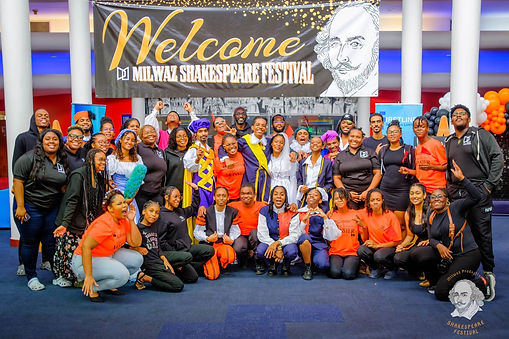
The journey to Verona is part of a larger cultural exchange.
Before arriving in Italy, the 25-member company will travel through the United Kingdom, engaging with key sites such as Stratford-upon-Avon and institutions central to Shakespearean performance and study.
This exposure reflects a broader trajectory for the company, which has consistently bridged Caribbean performance with international theatre spaces.
“This moment is not just about performing abroad—it is about placing Caribbean interpretation on the global intellectual stage.”
Before stepping onto the international stage, Malvolio’s Masquerade will be performed locally at the National Academy for the Performing Arts and the Southern Academy for the Performing Arts.
These performances serve as both fundraising initiatives and educational experiences—giving students and audiences the opportunity to witness Shakespeare through a Caribbean lens.
“To see Shakespeare through Caribbean eyes is to realise that these stories were never meant to belong to one culture alone.”
It is here, within local theatres and among familiar audiences, that the production’s impact is most immediate—bridging generations, sparking conversation, and reigniting interest in literature.
At its core, Malvolio’s Masquerade is about ownership—of stories, of culture, and of voice.
Shakespeare’s work has long been positioned as universal, yet often presented through narrow cultural frameworks. This production challenges that notion, asserting that universality is not found in sameness, but in reinterpretation.
“Shakespeare survives not through preservation, but through transformation.”
By placing Twelfth Night within the context of Caribbean Carnival, Milwaz Productions does more than adapt a classic, it expands its meaning.
And in doing so, it ensures that when the curtain rises in Verona, the world will not just see Shakespeare.
They will see the Caribbean.

.jpeg)

Click images below Donate or Purchase Tickets.
Let’s Work Together
Get in touch so we can start working together.


